
Every style blog seems to say something different about closets, and most of it ignores how you actually live. One voice says cut everything down to 30 pieces. Another says keep what you love and stop overthinking.
That mixed advice is frustrating, especially when your body, your schedule, and your taste have all changed. A capsule wardrobe for women over 50 can be a relief for some and a headache for others.
This guide compares both approaches in plain terms. You’ll see where each one shines, how to decide, and a simple middle path you can start today without emptying a single drawer.
What Actually Separates a Capsule From a Full Wardrobe

A capsule wardrobe is a small, planned group of pieces that all work together. Most tops go with most bottoms, and the colors get along. There’s no official number, but many people land somewhere around 30 pieces.
A full wardrobe is simply a bigger closet with more variety. It can hold statement pieces, seasonal items, and clothes for different events.
Neither one is automatically better. The real question is how many decisions you want to make each morning, and how much variety you need to feel like yourself.
When a Capsule Wardrobe Works Best
A smaller closet helps most when your days feel rushed or your clothes feel scattered. Here’s where it tends to pay off:
- Mornings feel like a puzzle. When everything mixes, you stop trying on five outfits before coffee.
- Your fit has changed. A few pieces that truly fit are easier to shop for than a closet full of “almost.”
- You travel often. Pieces in one color family pack into one bag and still make many outfits.
- You watch cost-per-wear. One well-made cardigan worn every week costs less per wear than three trendy tops worn twice.
- Your closet feels crowded. Fewer options make it easier to see what you actually reach for.
That’s why a capsule wardrobe for women over 50 often appeals to people who are retiring, downsizing, or rebuilding after a body change.
Try this: Hang your most-worn pieces at the front of the closet for two weeks. You’ll quickly see which ones are doing the real work.
When a Fuller Closet Makes More Sense

A bigger closet suits you when your life has real range. If one season includes weddings, church events, dinners out, and long walks, a tiny set of pieces will stretch thin.
It also makes sense if clothes are part of how you enjoy your day. Some women feel flat in a neutral palette. A bold print, a favorite jewel-tone blouse, or a vintage jacket can lift a whole week, and that counts.
Climate matters too. Four real seasons mean heavy coats, light knits, and sandals. A small one-season capsule can’t cover all of that without extra pieces.
The catch is upkeep. If you can’t see what you own, you’ll wear the same five things anyway.
Fabric note: Fold knits instead of hanging them. Hangers stretch the shoulders, and that’s often why a sweater suddenly looks tired.
Old Closet Rules You Can Retire

Closet advice often comes with strict numbers and color rules. This table swaps a few common ones for something more flexible.
| Old Rule | What Works Better |
|---|---|
| Own exactly 30 pieces | Own the number you can see, wash, and wear without feeling stuck |
| Stick to beige, black, and gray | Pick two or three colors you love near your face, then add one accent |
| Toss anything you haven’t worn this year | Keep a few occasion pieces, and try on anything you’re unsure about |
| A big closet is always a messy closet | Group clothes by outfit type so a large closet stays easy to read |
| Only buy “investment” pieces | Spend more on what you wear weekly, less on trend items |
These rules break down because they ignore your actual week. Someone who gardens, hosts dinners, and visits grandchildren needs a different mix than someone in an office.
Build a Small Core, Then Add Around It

Most women do best with a blend. A small core handles everyday life, and a looser group of favorites handles everything else.
The table below is a starter core you can check against your own closet. Adjust it for your climate and your routine.
| Piece | What to Look For | Mixes With |
|---|---|---|
| Straight or tapered pants in a dark neutral | Comfortable rise, a little stretch, hem that skims the shoe | Every top below, plus loafers or sneakers |
| Soft cardigan or open-front jacket | Medium-weight knit that drapes, shoulder seams that sit on your shoulder | Tees, shells, dresses |
| Three tops in your best colors | Smooth cotton, modal, or fine knit, with necklines you like | All bottoms and both layers |
| Midi skirt or easy dress | Fabric with some weight so it doesn’t cling, hem at mid-calf or just below the knee | Cardigan, denim jacket, flats |
| Two pairs of comfortable shoes | Cushioned insole and a secure fit, one casual and one dressier | Everything above |
Fit note: If a piece pulls, gaps, or needs constant adjusting, it won’t earn its spot, no matter how well it mixes.
Budget-friendly swap: Spend more on pants and shoes, since you’ll wear them most. Keep tops and accessories affordable.
Let the Fuller Closet Play Around the Core
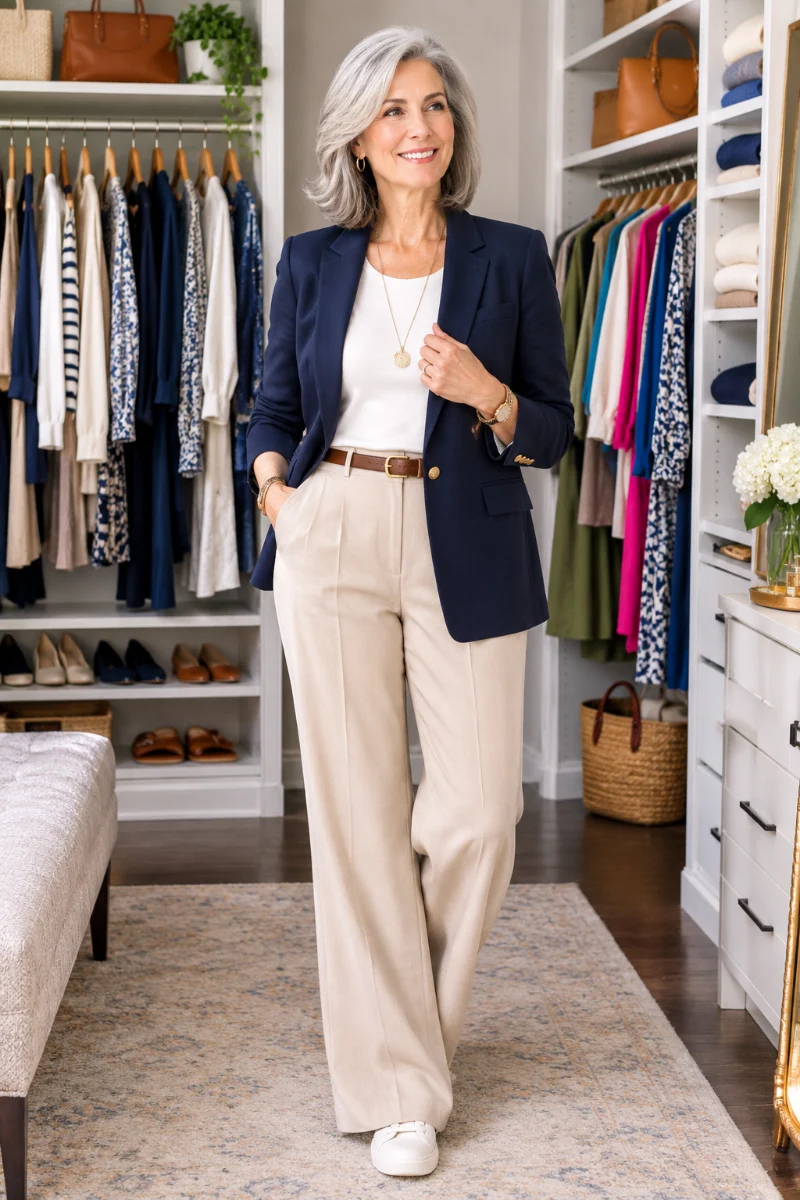
Once the core is in place, your favorite extras become the personality. A printed scarf, a bright blouse, or a great pair of earrings can sit on top of the same base pieces.
Here’s how a few real days might look.
| Occasion | Pieces | Why It Works |
|---|---|---|
| Errands and coffee | Tapered pants + tee + cardigan + sneakers | Soft layers and a closed shoe feel comfortable without looking sloppy |
| Lunch with friends | Midi skirt + fine knit top + statement earrings | The core skirt gets a personal touch from one accessory |
| Travel day | Dark pants + shell top + open-front jacket + slip-on shoes | Stretch fabric and dark color handle long sitting and small spills |
| Dinner out | Easy dress + structured jacket + low block heel | The jacket adds polish, and the low heel keeps the evening comfortable |
Formula: core bottom + core top + one “fun” layer or accessory.
It works because the base stays calm, so one interesting item stands out instead of fighting for attention. Swap the fun item by season or mood, and the same outfit looks new.
How to Decide in One Weekend

Skip the big closet purge. Pull out the 10 pieces you wore most in the last month and lay them on the bed. Notice what they share, like colors, fits, and fabrics.
If most of them mix easily, you lean toward a capsule. If they’re all over the place and you love that, a fuller closet suits you. Either answer is fine.
Then check for gaps. Can you make three outfits from just those pieces? If not, add one connector, such as a neutral cardigan, before buying anything else.
Frequently Asked Questions
How many pieces should a capsule wardrobe have after 50?
There’s no right number. Many people start around 25 to 35 pieces, including layers and shoes, then adjust. If you run out of outfits, add a piece. If you’re ignoring half of it, trim.
Can I keep my favorite clothes and still have a capsule?
Yes. Keep a small “love it” section outside the core. Pieces you adore still earn space if you actually wear them, even when they don’t match everything.
Is a capsule wardrobe boring?
It doesn’t have to be. Color, texture, and accessories carry your personality. Changing a scarf, earrings, or one layer can make the same base outfit look completely different.
Is a capsule wardrobe cheaper?
It can be, because you buy fewer items and wear each one more, which lowers cost-per-wear. It depends on what you choose, though. A cheap piece that doesn’t fit still wastes money.